Tcl Qm7K Tv Specs, Features, and Value: Is it worth the price tag?
Introduction
The Tcl Qm7K TV positions itself in the competitive 4K television market as a value-oriented model that blends modern smart-TV features with a focus on picture performance. For buyers weighing options for a living-room centerpiece, a dedicated gaming display, or an upgrade for a bedroom or secondary TV, the QM7K promises a combination of quantum-dot color enhancement, contemporary smart-platform convenience, and a design that fits modern interiors.
This article examines the QM7K from multiple angles: what it offers out of the box, its likely specifications and real-world performance, strengths and weaknesses, who benefits most from this model, and whether it represents good value at its typical price point. The analysis is written for practical buyers—people who care about picture fidelity for movies and sports, responsiveness and low latency for gaming, integration with streaming services, and the long-term cost of ownership.
What the Tcl Qm7K aims to deliver
At a glance, the QM7K is presented as a mid-to-upper mid-range 4K TV in TCL’s lineup. The model emphasizes vivid color reproduction—often via quantum-dot technology in TCL’s naming conventions—along with a modern smart-TV interface and a clean, near-bezel-less design. It targets households that want better-than-basic visual performance without stepping up to the highest-priced mini-LED or OLED alternatives.
Detailed product review and analysis
Design and build
The QM7K typically features a slim chassis with narrow bezels, a low-profile stand option, and a fairly light weight for its screen size. The physical build aims to balance aesthetics and affordability: most finishes are matte to reduce reflections, while the screen mounting points adhere to common VESA standards for third-party wall mounts.
From a practical perspective, the TV’s design suits living rooms and media rooms where a minimal look is preferred. Cable management on the stand or back panel is usually modest—adequate for a standard setup but not as refined as some premium models that hide more cabling behind a pedestal.
Display and picture quality
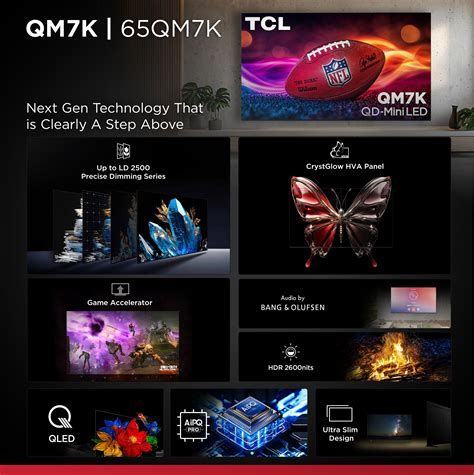
Many of the QM7K’s selling points revolve around picture performance. The TV is commonly offered with a 4K (3840 x 2160) resolution panel and enhanced color processing intended to expand the color gamut beyond standard LED LCDs. Key picture-related elements to consider:
- Resolution: Native 4K resolution for sharper text and fine detail on screen.
- Color: Quantum-dot or enhanced color processing helps produce richer hues and more saturated colors compared with basic LED panels.
- HDR support: The QM7K supports mainstream HDR formats such as HDR10 and HLG; higher-tier models may include Dolby Vision compatibility—buyers should verify the specific SKU for Dolby Vision support.
- Local dimming and contrast: The TV may include a local dimming system (edge or full-array depending on size and sub-model) that improves contrast and black levels but will not typically match the absolute black of OLED displays.
- Refresh rate: A native 60Hz refresh rate remains common on mid-range sizes, while some sizes or SKUs may offer a 120Hz panel for smoother motion—especially relevant to gamers and sports viewers.
In controlled viewing, the QM7K delivers pleasing color and adequate brightness for most living-room environments. For viewers who prioritize deep, cinematic blacks (home theater purists) or perfect motion handling for high-frame-rate competitive gaming, higher-end alternatives may be preferable. Still, for streaming movies, broadcast TV, and casual gaming, the QM7K keeps up well.
Smart platform and user experience
TCL has historically used both Roku TV and Google TV (Android TV) across different markets. The QM7K model often ships with a modern smart platform that provides fast access to major streaming services, voice assistants, and a straightforward content-discovery interface. Buyers should check the regional SKU to confirm whether the unit uses Google TV, Roku, or TCL’s own interface.
Key smart features to expect:
- Pre-installed apps for major streaming services and access to their app stores.
- Voice control integration (Google Assistant or compatible voice services) and basic smart-home interoperability.
- Regular over-the-air firmware updates from TCL and the platform provider, though update cadence can vary by region and model.
For families and streaming-first households, the smart experience is central. The QM7K aims to be responsive and simple rather than feature-heavy, making it friendly for users who want reliable access to Netflix, Disney+, Hulu, and broadcasting apps without complicated menus.
Shop the latest TVs & Home Theater picks on Amazon.
Browse Now →Audio, connectivity, and ports
Built-in audio on the QM7K is serviceable for everyday TV-watching: dialog clarity is prioritized, but bass depth and immersive soundstage are limited by the thin chassis. The TV typically includes audio enhancements such as virtual surround processing and support for Dolby audio formats. For viewers who want fuller sound, pairing the TV with a soundbar or AV receiver is recommended.
Connectivity varies by SKU, but practical expectations include:
- Multiple HDMI inputs (often 3 or 4), with at least some ports offering enhanced audio return channel (eARC) or higher bandwidth (check which ports are HDMI 2.1-capable if gaming at high frame rates is a priority).
- USB ports for media playback and service updates.
- Wi-Fi and Ethernet for streaming, plus Bluetooth for connecting accessories (keyboards, soundbars, headphones).
Consumers focused on consoles and PC gaming should verify the exact HDMI version and whether the model supports gaming features such as ALLM (Auto Low Latency Mode), VRR (Variable Refresh Rate), and 4K@120Hz passthrough—higher-tier SKUs or larger screen sizes are more likely to include these capabilities.
Performance in real-world use
Real-world performance depends on viewing environment and how the TV is used. In bright rooms, the QM7K’s anti-reflective coating and moderate peak brightness keep images readable, though it will not produce the punchy HDR highlights of premium flagship sets. For evening movie sessions in darker rooms, the local dimming feature helps but may show modest haloing around bright objects if the TV uses edge dimming.
For gaming, input lag is often competitive for the class when the TV is set to a game mode. Casual and console gamers will find the responsiveness acceptable; competitive esports players looking for the absolute lowest latency and fastest pixel response may prefer a display with a verified sub-10ms input lag and higher refresh rates.
Who should consider the Tcl Qm7K?
The QM7K is a fit for several buyer profiles:
- Families who stream a variety of content and want better color and smart functionality than entry-level sets.
- Casual gamers who want a big-screen experience with reasonable responsiveness and optional gaming features.
- Viewers who prioritize price-to-performance and want a modern user interface with app availability and voice control.
It is less well-suited to buyers who require the deepest blacks and absolute motion handling (home theater enthusiasts and competitive gamers) unless they select a higher-tier competitor model or higher-end TCL SKU.
Pros & Cons
- Pros
- Good color reproduction: Quantum-dot enhancement or equivalent color processing provides vivid and attractive colors for movies and TV shows.
- Modern smart platform: Easy access to major streaming services and voice assistant support in most SKUs.
- Attractive price-to-performance: Delivers many features typically found in more expensive TVs at a lower price point.
- Flexible connectivity: Multiple HDMI and USB ports make it simple to hook up consoles, soundbars, and external storage.
- Cons
- Limited peak brightness and contrast: Does not match OLED or top-tier mini-LED displays for absolute HDR pop and deep blacks.
- Variable feature set by SKU: Gaming features, Dolby Vision support, and HDMI 2.1 availability can depend on screen size and market—buyers must verify the exact model.
- Audio is adequate but not exceptional: A soundbar or external audio system is recommended for immersive viewing.
- Local dimming artifacts: On some scenes, haloing can be noticeable if the model uses edge-local-dimming rather than full-array local dimming with many zones.
How the QM7K compares to other options
| Category | TCL QM7K | Typical Mid-Range 4K LED | Premium Mini-LED / OLED |
|---|---|---|---|
| Picture quality | Enhanced color, solid 4K detail, improved HDR for price segment | Good detail, narrower color gamut, basic HDR | Superior contrast, deeper blacks, more precise HDR highlights |
| Smart platform | Modern, fast, app-rich (Roku/Google TV dependent) | Varies; some use older platforms with fewer features | Top-shelf platforms with regular updates and advanced features |
| Gaming | Competitive for casual gaming; some SKUs include VRR/ALLM | Often lacks advanced gaming features | Full HDMI 2.1 feature set, low input lag, high refresh rates |
| Value | High—good balance of features per dollar | Moderate—cheaper but fewer features | Lower value per dollar but best performance |
Buying guide: what to check before purchase
When considering the QM7K, buyers should verify the SKU and compare it against personal priorities. The following checklist helps ensure the purchased unit matches expectations:
1. Confirm the exact model number and regional SKU
The QM7K naming may encompass multiple screen sizes and regional variants. Confirm the full model number and check the manufacturer’s product page or the retailer’s specification sheet for specifics about HDR formats, HDMI versions, and platform differences.
2. Look for HDR and picture-mode support
Verify which HDR formats the unit supports (HDR10, HLG, Dolby Vision). For cinephiles, Dolby Vision is a marked benefit because it offers more scene-by-scene dynamic metadata for supported content.
Discover deals on TVs & Home Theater — updated daily.
Shop Amazon →3. Check gaming credentials if relevant
If gaming is a priority, make sure the model explicitly lists VRR, ALLM, and the ability to accept 4K@120Hz input on at least one HDMI port. Also look for an advertised input lag figure in game mode.
4. Consider size and viewing distance
Choose screen size based on typical viewing distance. For 4K content, larger screen sizes deliver more impact. A living room where the couch is 8–10 feet from the screen commonly suits 55–75" displays depending on room layout.
5. Plan for audio
Factor in audio needs: if the goal is a cinematic soundstage, budget for a soundbar or AV receiver. The TV’s eARC support simplifies connecting an external audio system with minimal compromise.
6. Warranty and firmware updates
Review TCL’s warranty terms for the model and the expected firmware update cadence for the smart platform. Regular updates enhance longevity and can add features or fix issues over time.
Real-world use cases
To help translate specs into practical expectations, here are common scenarios and how the QM7K performs:
- Movie nights: The QM7K offers vibrant colors and good HDR handling for streaming movies. For viewers who sit in a dark room and demand the absolute deepest blacks, consider comparing to OLED alternatives first.
- Sports: The color punch and motion processing make the QM7K a solid pick for watching fast-paced sports on weekends. Verify that the panel and motion interpolation settings are tuned to avoid artificial motion artifacts.
- Family streaming TV: For households that share streaming services, the smart platform and app availability provide an easy, frustration-free experience for varied viewing habits.
- Console gaming: Casual and console gamers will appreciate the large-screen immersion and responsive game mode. Competitive players should confirm refresh rate and VRR support on the exact SKU.
- Secondary rooms (bedrooms, guest rooms): Mid-size QM7K models provide an excellent balance of performance and price for secondary TVs where space and budget are more constrained.
Conclusion
The Tcl Qm7K TV is a thoughtfully positioned model that delivers much of what modern viewers expect from a mid-range 4K television: strong color reproduction, a friendly smart-TV experience, and practical connectivity for today’s living rooms. It strikes a favorable balance for buyers who want better-than-basic picture quality and modern features without paying a premium for the very top-tier displays.
However, the QM7K is not the final word on picture perfection. Buyers who demand ultra-deep blacks, the brightest HDR highlights, or the most advanced gaming feature set should compare it directly with premium mini-LED or OLED alternatives. Because some key features—HDMI versions, Dolby Vision, or higher refresh rates—can vary by size and regional SKU, careful verification of the specific model number is essential before purchase.
In short, for most families, streaming enthusiasts, and casual gamers, the QM7K represents strong value: it is worth considering when the priorities are vivid color, modern smart features, and an attractive price-to-performance ratio. For specialized high-end needs, a comparison with premium models will clarify whether the extra investment is justified.